
Gamdom Originals: The Complete Guide to Their In-House Games
Crash, Mines, Plinko, Towers and the rest of the Gamdom Originals line. gameplay, RTP, math, and where the real edges live.
Visit Gamdom
Every casino claims "in-house games." Most of the time, that means a white-labelled slot engine with a reskinned logo. Gamdom Originals are different: six to eight games built and operated by Gamdom directly, with cryptographically verifiable outcomes, transparent RTP, and, in Crash's case, the single highest return-to-player of anything on the site.
This is the complete guide. What each game is, how its math works, where the real edges live (and don't), and why "provably fair" is one of the few pieces of casino marketing that's actually technical, not theatre.
Play the OriginalsWhy Originals matter more than slots
A Pragmatic slot runs at 96.50% RTP. a number you have to trust based on studio audits and certified labs. The house edge is 3.5% and you cannot independently verify any individual spin. That isn't fraud; it's the architecture of third-party slot integrations.
Gamdom Originals invert this. The RTP is published, the algorithm is published, and every round outcome is a deterministic function of a server seed (committed before the round starts), a client seed (which you can set yourself), and a nonce that increments each play. Before the round, you see the hash of the server seed. Afterwards, the seed is revealed and anyone. you, a stranger on Discord, a skeptical journalist. can rerun the math and get the same multiplier.
That doesn't mean you'll win. It means you know exactly what you're up against. For the wider context on how provably fair actually verifies a result, the cryptographic primitives at work across crypto casinos are covered in detail in our fairness explainer.
Crash
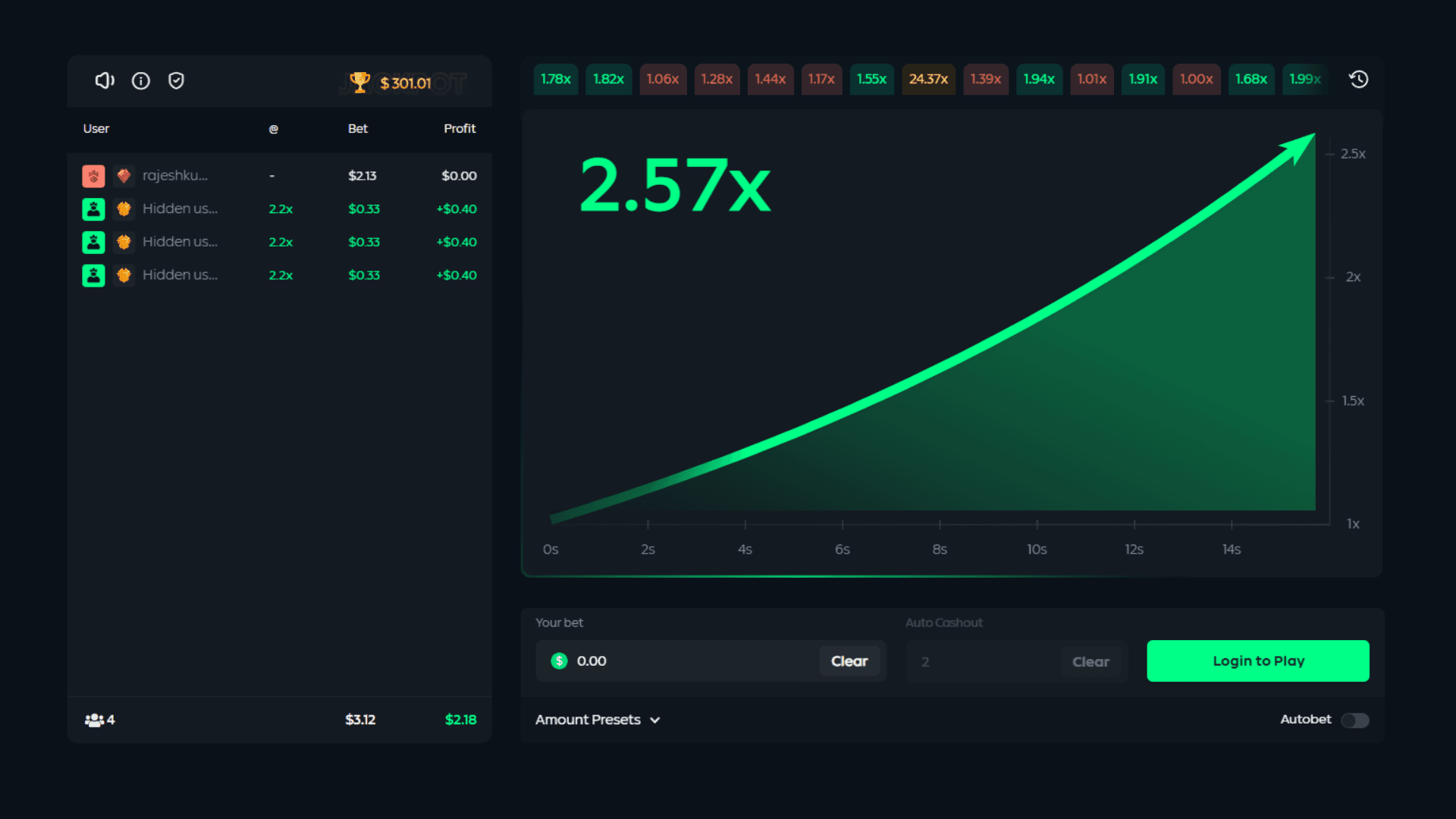
Crash is the game most new Gamdom players open first. It's simple: a multiplier starts at 1.00× and climbs. Any time before it crashes, you can cash out at the current multiplier and take your stake × that number. Wait too long, the curve crashes, and your stake is gone.
The math: Crash has roughly a 1% house edge, meaning a theoretical RTP of around 99.0%. The cap varies by round but often exceeds 1,000×. Every multiplier is drawn from a published distribution; the expected value of cashing out at any multiplier is identical (minus that 1% tax). There's no "optimal" number mathematically. but most serious players sit at a low, consistent cash-out like 1.5× or 2× to smooth variance.
Crash has two dangerous illusions. First, the gambler's fallacy: a string of early crashes does not mean the next round is "due" a big number. Second, the auto-bet martingale trap: doubling your stake after losses feels mathematical, but the bankroll required to survive ten consecutive sub-2× rounds is an order of magnitude larger than most players have. Pick a strategy; size positions correctly; don't chase.
Mines
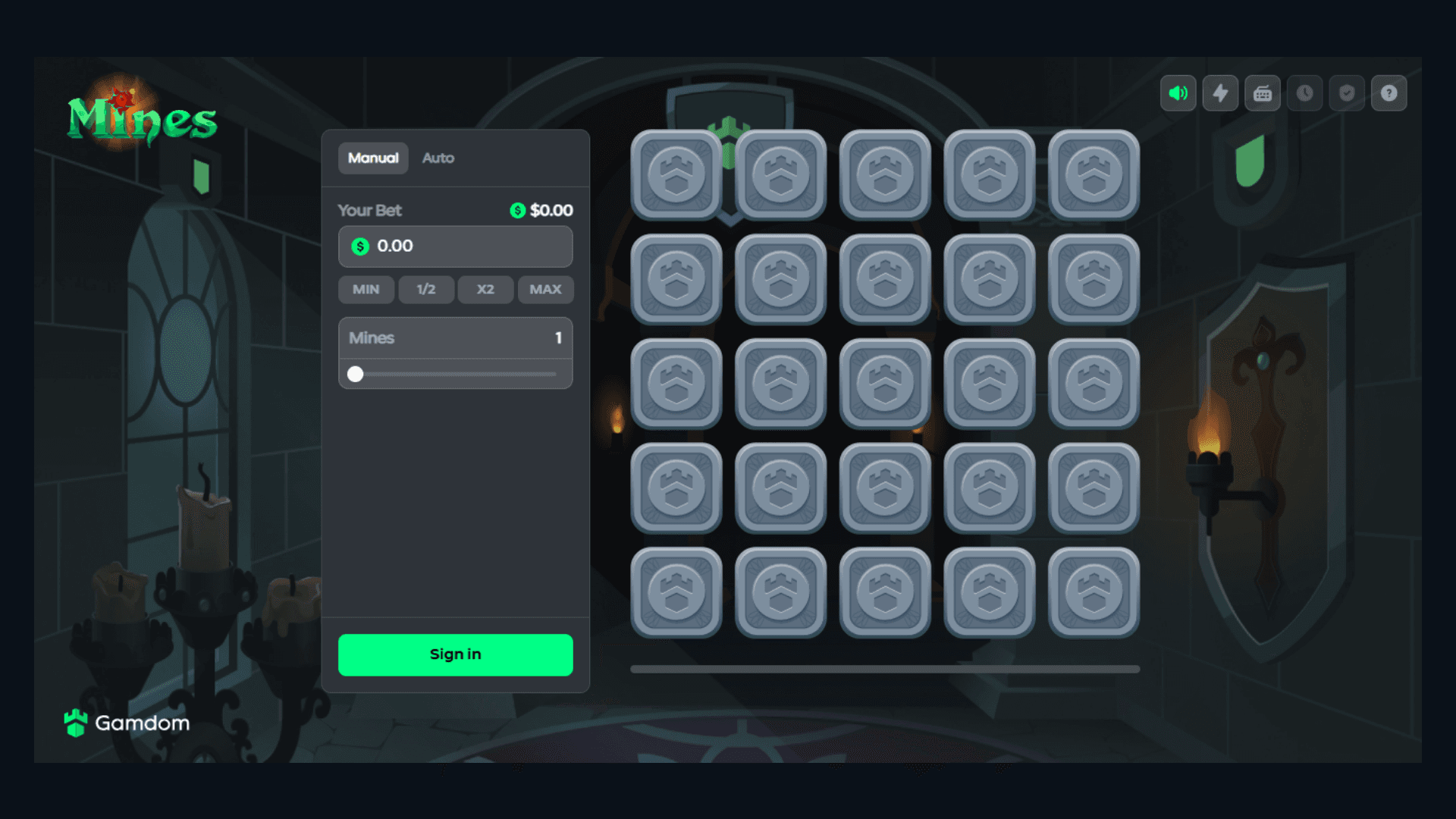
Mines is a grid of covered tiles with a configurable number of mines hidden underneath. You reveal tiles one by one. each safe reveal bumps your multiplier. and you can cash out at any point. Hit a mine and you lose your stake.
The math is exact and public. With 3 mines on a 25-tile grid, revealing your first safe tile pays 1.13×. Reveal three and you're at 1.49×. Reveal ten and you're over 5×. RTP floats around 97 to 99% depending on how many mines you select; more mines = higher volatility and a slightly worse effective return.
Mines is the Gamdom Original most misunderstood by new players. The temptation is to keep going. "just one more". but the risk of ruin curve steepens sharply past 3× or 4×. Most experienced players either (a) set an auto cash-out and walk, or (b) treat it as a coin-flip game at high multipliers and size accordingly.
Plinko
Plinko drops a ball down a pegged pyramid; it bounces randomly left or right and lands in a bottom bucket that pays a multiplier. You choose the risk level (low / medium / high) and row count (8 to 16). Higher risk and more rows = wider multiplier spread (0.2× to 1,000× at the extremes).
Expected value is fixed at roughly 99% across every configuration. What changes is variance: low-risk Plinko feels like a slow slot, high-risk Plinko feels like a binary bet. Neither is "better" mathematically. it depends on the shape of variance you can tolerate.
Towers
Towers is a vertical climb. Each floor has tiles; one or more contain a skull; you pick one and, if safe, advance. Each floor you clear raises the multiplier. Cash out whenever. Hit a skull and lose everything.
The variants (easy / medium / hard / master) differ in tile-to-skull ratios. Master mode. one safe tile out of four per floor. has brutal variance but multipliers that stack into five-figure territory fast. Expected value is again around 97 to 99%; master's variance swallows most casual bankrolls before the math asserts itself.
Try Mines and TowersDice
Gamdom's Dice is the classic crypto-casino bet: pick a target number and a direction (roll over / roll under). Your win probability and payout adjust automatically. bet on rolling over 98 and you get 49× on a ~2% hit rate; bet on rolling over 50 and you get ~2× on roughly half the rolls.
RTP sits at 99%. Dice is the "cleanest" Original mathematically. there's no embedded feature, no bonus round, no volatility trick. It's the game most often used for automated play scripts because its behavior is utterly predictable.
Other Originals
Gamdom has added and rotated smaller Originals over time. Hi-Lo (card prediction), Blackjack (their in-house variant, not the live dealer version), Keno, Limbo (pick a multiplier target; the game rolls one; you win if it's equal or higher). Each follows the same pattern: provably fair, ~97 to 99% RTP, simple ruleset.
None of them are "better" than Crash in pure return. Where they differ is in the shape of variance, session length, and how they feel to play. If Crash gives you decision fatigue, a five-minute Limbo session at a 10× target (with, say, a 9.9% hit rate and 10× payout) is structurally similar but takes the click out of cash-out timing.
The provably-fair verification, step by step
Every Gamdom Original round, regardless of game, follows this pattern:
- Before the round, the server publishes a SHA-256 hash of a secret server seed.
- During the round, you choose a client seed (the system generates one if you don't).
- The outcome is computed as a deterministic function of (server_seed, client_seed, nonce).
- After the round, the server seed is revealed. You, or any third-party verifier, can hash it, confirm it matches what was published, and then reproduce the outcome from scratch.
If either the server seed or the client seed is changed after commitment, the hashes won't match. If the algorithm is altered, independent verification won't reproduce the outcome. This is the same cryptographic primitive used in, for example, commit-reveal blockchain protocols.
What this doesn't fix
Provably fair doesn't mean you'll win. It doesn't mean the house edge is zero. It doesn't eliminate variance. What it does eliminate is a specific class of fraud: the operator cannot peek at your bet before generating an outcome, cannot cheat on individual rounds, and cannot lie about the distribution.
It also doesn't protect you from yourself. The most dangerous Original isn't the one with the highest house edge. it's the one you'd chase losses on.
Rakeback on the Originals
One underdiscussed angle: Gamdom Originals count toward rakeback like every other wager. Because the Originals have very high published RTPs, each dollar wagered generates a small house margin, which in turn generates rakeback. For high-volume players who live in the Originals, the net cost-of-play after rakeback comes out competitively against the rest of the casino floor.
The full rakeback breakdown is in our Gamdom Rakeback Guide. The short version: play Originals, tier up, compound the return.
Bottom line
Gamdom Originals are the honest end of a casino floor. Transparent math, cryptographic verification, published house edges, and return-to-player numbers that rival the best slots in the industry. They won't make you a winner. no casino game will. but they give you something rarer than that: the ability to know, down to the bit, what you're playing.
If you've never played a provably-fair game before, start with Crash at a 1.5× auto cash-out and ten bets. The rhythm is the point.
Play the Originals on Gamdom